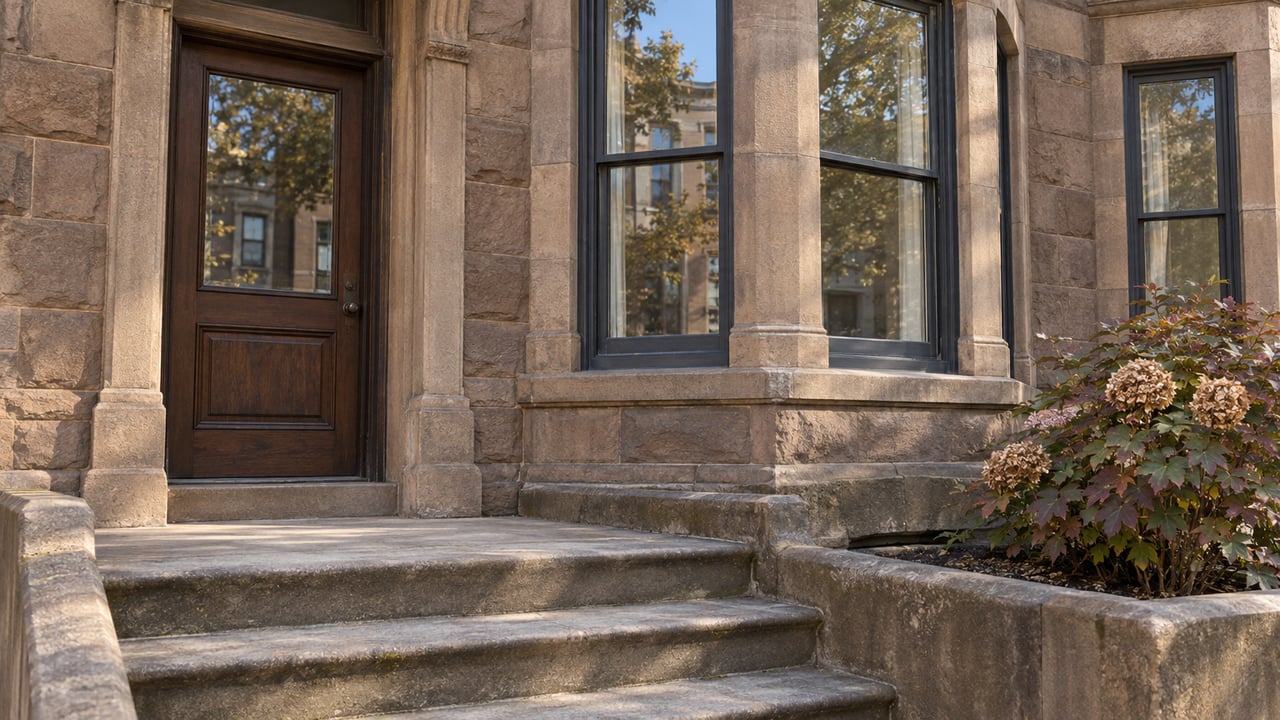
Pacific Park's Next Phase Runs in a Fixed Order. The Rail-Yard Blocks Come Last.
October 15, 2026
October 15, 2026
"The goal of this sequencing and this structure is to ensure that the largest buildings with the most and deepest affordability are commencing as quickly as possible." Arden Sokolow, Empire State Development's executive vice president of real estate and planning, said this at a September board meeting of the Atlantic Yards Community Development Corporation, as The Real Deal reported.
Most coverage of the next phase of Pacific Park, formerly Atlantic Yards, has focused on the totals. The project would grow from 6,430 homes to about 8,800, and one tower would rise to 799 feet. Those totals say little about what happens next to a Prospect Heights townhouse on Dean Street or a condo on Vanderbilt Avenue. The memorandum of understanding is built as a series of steps, and each step depends on the one before it. The blocks that border Prospect Heights come late in that series, and the money for them is only partly in place.
On July 28, 2026, Empire State Development (ESD) signed a nonbinding MOU with the development team led by Cirrus Real Estate Partners and LCOR. The document says that binding agreements still depend on environmental review and an amended project plan. Within that framework, the order of construction looks like this:
ESD put the logic in plain terms. Build where construction is simplest, then move east over the tracks. In this plan, east means toward Prospect Heights.
The schedule in the MOU has unusual conditions attached to it. Here are the milestones as they are currently written:
| Milestone | Target | Condition attached |
|---|---|---|
| First platform, Block 1120 | End of 2032 | Depends on $350M in state funding, of which $175M has been appropriated |
| Site 5 and Block 1120 buildings | End of 2037 | Same extension options as the platform |
| Block 1121 buildings | End of 2040 | Only if a funding agreement for that parcel has been executed |
| Block 1121 buildings, fallback | End of 2042 | Applies regardless of funding |
The dates also come with a price for slipping. If the first platform runs past 2032, the developers can buy a one-year extension with a $500,000 contribution and a second year with $1 million. ESD can allow further extensions at its discretion.
The more immediate question is the money for the platform itself. Under the MOU, the Block 1120 platform and its infrastructure depend on $350 million in state money, and so far $175 million has been appropriated. The MOU also calls for a funding agreement that "requires a showing of full capitalization before funds are dispersed." At the September board meeting, Sokolow said ESD is working with the Governor's office to find the other $175 million but could not yet name the source.
The conditions build on each other. The first platform needs the missing $175 million. The second platform needs all of the first platform's buildings and Site 5 to be under way. The earlier Block 1121 date needs its own funding agreement. If any of those steps slows down, everything after it slows down too. The blocks closest to Carlton and Vanderbilt sit at the far end of that chain.
For buyers on the Prospect Heights side, the most direct change in the plan is a parcel that will have no building on it. The MOU replaces Building 8 with "a dedicated open space area." Phase II would include more than five acres of public space, and the project as a whole would have more than eight acres, counting what already exists on Block 1129. The Draft Scope of Work says this space would have street access from Carlton Avenue to the west and Atlantic Avenue to the north. Small buildings such as restrooms and food kiosks could go there. It would connect through the old bed of Pacific Street to the open space that is already built.
The completed buildings at 535 Carlton and 550 Vanderbilt stand on the Pacific Park block south of Pacific Street, next to that existing open space. That puts the new open space close to existing homes. It is also on Block 1121, the last block in the order, with buildings targeted for 2040 or 2042. The MOU also leaves the question of who manages it open. Pacific Park Conservancy is one option. Other nonprofits and NYC Parks are also on the table.
550 Vanderbilt is the only condominium building in Pacific Park. Its 2026 closings show what buyers are paying today, with the next phase still unbuilt. Several recorded sales this year:
The July sale had changed hands before. That unit closed at $860,000 in October 2017, in a sale that records list through the sponsor's sales gallery, so it changed hands for $120,000 more about nine years later. That figure is not adjusted for inflation or closing costs.
These sales show prices only. We found no local reporting that ties the MOU, or the long-empty rail yard, to any measurable change in values or buyer behavior on Dean, Pacific, Carlton or Vanderbilt. The broader Brooklyn picture is mixed. Douglas Elliman's Brooklyn Q3 2026 report, with data as of October 1, 2026, shows borough-wide recorded sales down 9.0% year over year and the median recorded price up 5.4%. Brooklyn condo contracts fell 13.6%. Those are borough figures, not Prospect Heights figures.
Supply is also arriving on a separate track. Eight80 BK at 880 Atlantic Avenue, a 19-story rental by EMP Capital Group with 65 income-restricted apartments, finished construction on October 1, 2026. New York YIMBY counts 257 units in total, and Brownstoner counts 258. Pacific Park's illustrative Phase II program includes 1,000 condos, alongside roughly 4,600 rentals of which 1,242 would be income-restricted. That condo count would be new competition for 550 Vanderbilt, but on the platform timeline it is still years away.
ESD released the Draft Scope of Work for a Second Supplemental Environmental Impact Statement on August 24 and held a virtual scoping meeting on September 24. Written comments are accepted until 5 p.m. on Monday, October 26, 2026, by email to [email protected] or by mail to ESD's office at 655 Third Avenue. The scope decides what the environmental review will study. It does not approve the project.
Prospect Heights groups are already engaged. BrooklynSpeaks submitted a statement on September 22. It asks for review of the whole project and its cumulative effects, Site 5 traffic on Pacific Street, arena traffic, a scenario in which Block 1121 is delayed, and accountability for construction complaints. At the September board meeting, Gib Veconi, who chairs the Prospect Heights Neighborhood Development Council, pointed out that the original plan called for 900 apartments for households earning under 60% of area median income. The current plan targets 232, The Real Deal reported.
Is any of this approved? No. The MOU says it is nonbinding. Final agreements depend on the environmental review and on an amended project plan.
Would the new buildings include family-sized apartments? The MOU requires at least 30% of units in each Phase II building to have two or more bedrooms. Developers can ask for adjustments, but each of the three components must still meet that 30% floor.
Does Site 5 have to include a hotel? No. The plan allows a hotel of up to about 92,000 square feet but doesn't require one. If the hotel is built, total Phase II housing drops from 5,600 units to 5,420.
If you're weighing a home on the blocks near the rail yard, The Mazurek Team can go through what's scheduled for the neighboring parcels and how recent sales nearby compare. We'll explain the process plainly so you can decide what the timeline means for your plans.
This article is general information, not legal, tax or financial advice. Consult a qualified professional about your situation.
Stay up to date on the latest real estate trends.


With a proven track record and a commitment to excellence, The Mazurek Team offers a tailored, hands-on approach designed to deliver exceptional results.